
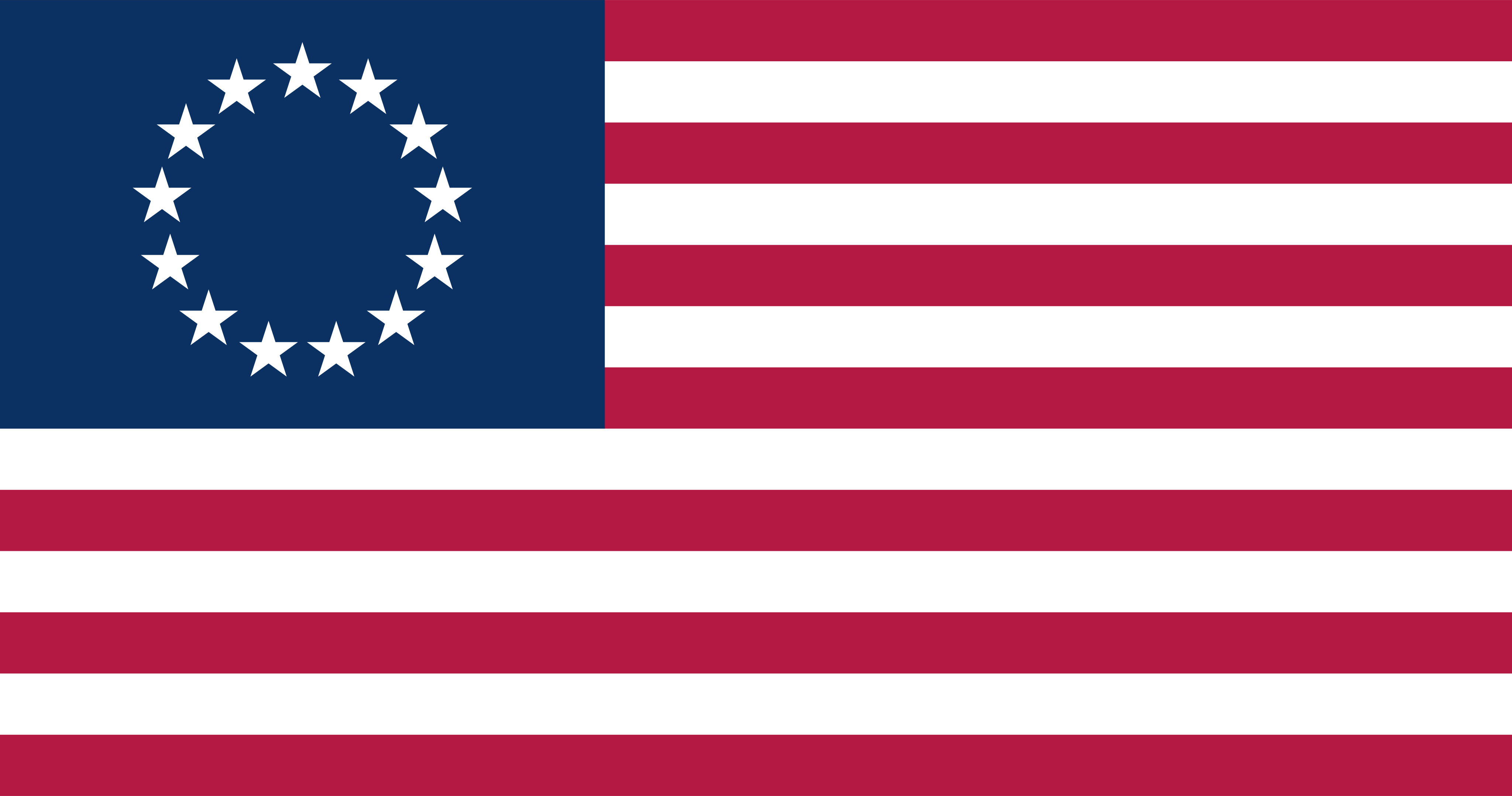
The flag of the United States is not one design but a living document, officially changed 27 times as the nation grew. Each version tells you the size of the country that flew it. Here is how the Stars and Stripes evolved, from a hasty wartime banner to the longest-serving flag in American history.
Before the stars: the Grand Union Flag
The first flag to represent the united colonies was not the Stars and Stripes at all. The Continental Colors, often called the Grand Union Flag, flew from late 1775. It carried the thirteen red and white stripes we still know, but in place of stars its canton held the British Union flag. It captured the colonies' position at the time: united in resistance, not yet declaring full separation.
Independence made that canton untenable. A new nation needed a banner with no other country inside it.
1777: a new constellation
On June 14, 1777, the Continental Congress passed the Flag Resolution: "Resolved, That the flag of the United States be thirteen stripes, alternate red and white; that the union be thirteen stars, white in a blue field, representing a new constellation."
That single sentence is the entire founding document of the American flag, and it is remarkable for what it leaves out. It says nothing about how the stars should be arranged, how many points they should have, or what proportions the flag should take. Early flagmakers improvised: stars in rows, stars in a circle, stars scattered like the night sky. The date of the resolution is why we celebrate Flag Day on June 14.
1795: fifteen stars, fifteen stripes
When Vermont and Kentucky joined the union, Congress updated the flag the only way that seemed fair: a star and a stripe for each new state. The 1795 flag carried fifteen of each, and it is the single most famous version of the flag ever made. It was a 15-star, 15-stripe garrison flag that flew over Fort McHenry in September 1814 and moved Francis Scott Key to write "The Star-Spangled Banner."
But the arithmetic had a problem. The nation kept growing, and a flag that added a stripe per state would eventually look like pinstripes.
1818: the rule that saved the stripes
The Flag Act of 1818 settled the design logic that still governs the flag today, returning the stripes permanently to thirteen in honor of the original colonies, and adding one star for each new state. New stars are added on the Fourth of July following a state's admission. From then on, the stripes told the story of the founding and the stars told the story of the growth.
Thirteen stripes for where the country began. One star for every state it became.
Through the nineteenth century the star field changed constantly as the map filled in, and there was still no official arrangement. It took an executive order by President Taft in 1912 to standardize the flag's proportions and the orderly rows of stars for the 48-star flag, which then served through two world wars and 47 years, the record at the time.
1959 and 1960: the last two stars
Alaska's statehood brought a 49-star flag on July 4, 1959. It lasted exactly one year, the shortest-serving star count of the modern era, because Hawaii was right behind. On July 4, 1960, the 50-star flag was raised for the first time.
Its design has a story of its own: a 17-year-old Ohio student named Robert Heft sewed a 50-star flag for a class project in 1958, betting that Alaska and Hawaii would both join the union. His teacher gave him a B minus. Two years later his arrangement was flying over the Capitol.
The longest-serving flag in American history
The 50-star flag has now flown for more than six decades, far longer than any earlier version. Every previous design was a snapshot of a growing country; this one has become the fixed image of America for most living memory, carried to the Moon, planted at the poles, folded into thirteen ceremonial triangles at military funerals, and raised over every statehouse each morning.
If a 51st state ever joins the union, the tradition is ready: a new star, added the following Fourth of July, and a 28th official flag of the United States.
See the major versions side by side in the illustrated timeline on The Flag, learn the rules for displaying today's flag in the U.S. Flag Code, or keep exploring Flag Stories.