
The most important flags in American history did not disappear into legend. Most of them survive, carefully preserved and on public display. If you want to stand in front of the actual cloth that made history, here is where to go.
The Star-Spangled Banner: Washington, D.C.
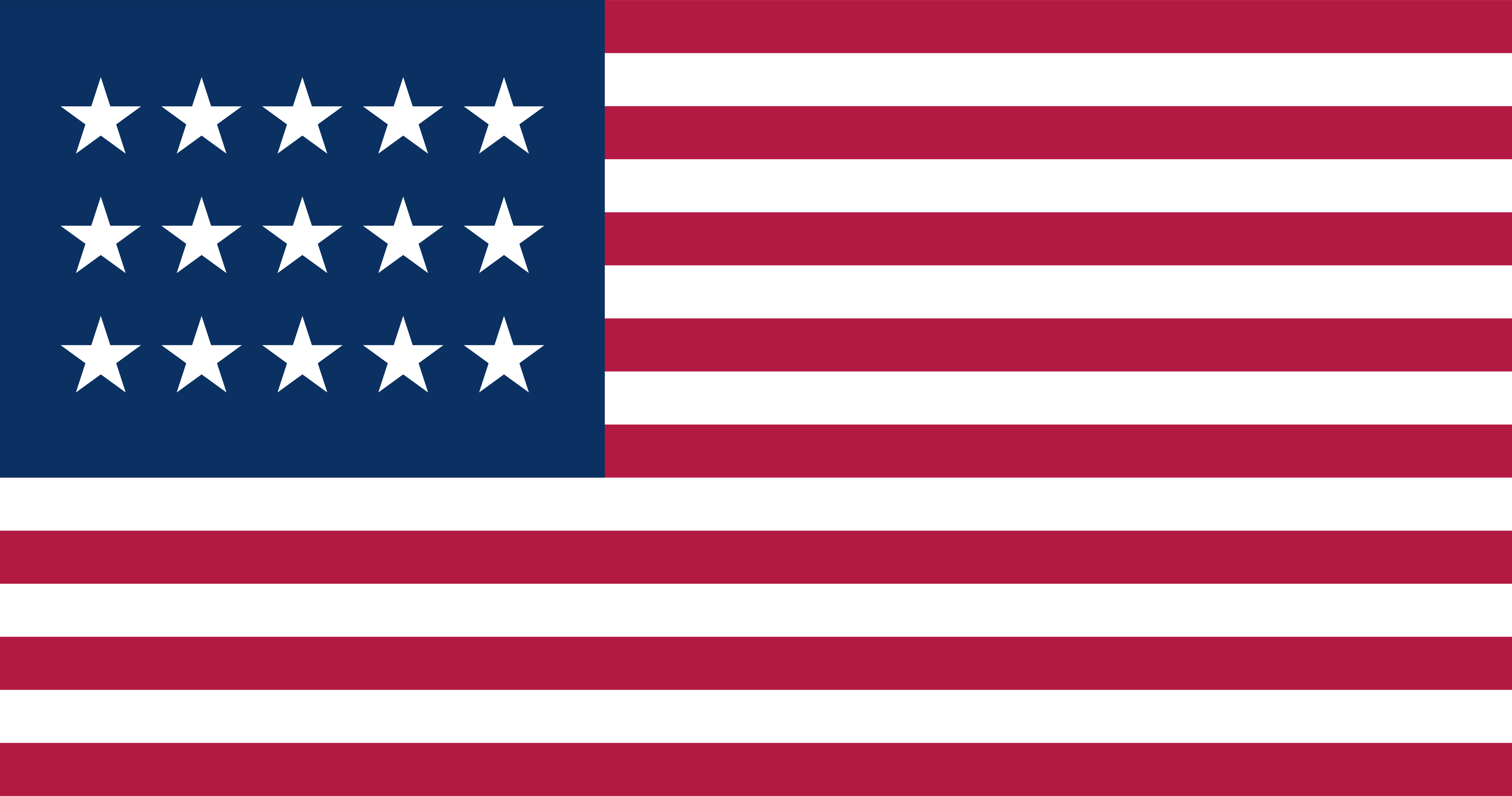
The flag that inspired the national anthem, a 15-star, 15-stripe garrison flag sewn by Baltimore flagmaker Mary Pickersgill and flown over Fort McHenry during the British bombardment of September 1814, lives at the Smithsonian's National Museum of American History. It is displayed in a climate-controlled chamber at a gentle angle in low light, every condition calibrated to preserve what remains of the wool and cotton. Seeing its sheer size in person, originally 30 by 42 feet, explains instantly why Francis Scott Key could spot it from a ship.
Old Glory: Washington, D.C.
The original "Old Glory," the personal flag of sea captain William Driver, who hid it from Confederate searchers inside a bedcover until Union troops took Nashville in 1862, is also held by the Smithsonian. The name he gave one flag eventually became a nickname for every American flag, but the original is a specific, surviving object.
The Iwo Jima flags: Triangle, Virginia
Two flags were raised on Mount Suribachi on February 23, 1945; the second raising became the most reproduced photograph of the war. Both flags are preserved at the National Museum of the Marine Corps in Triangle, Virginia, just off I-95 south of Washington. The museum's soaring glass atrium was itself designed to evoke the angle of the flag-raising.
The Ground Zero flag: New York City
The flag raised by three firefighters over the rubble of the World Trade Center on September 11, 2001, photographed in an image that became the era's answer to Iwo Jima, disappeared within hours and was missing for more than a decade. Identified and authenticated years later, it is now displayed at the National September 11 Memorial & Museum in Lower Manhattan.
These are not replicas. This is the actual cloth that was there.
The Fort Sumter flag: Charleston, South Carolina
The 33-star garrison flag that flew over Fort Sumter when the Civil War began in April 1861 was lowered, carried north, and used for years to rally Union support. It returned to the fort exactly four years later for a symbolic re-raising. Today the surviving Sumter flags are in the care of the National Park Service at Fort Sumter, reachable by ferry from Charleston Harbor.
The flagmakers' houses
Two homes connected to famous flags are museums you can walk through:
- The Betsy Ross House, Philadelphia. The home associated with the upholsterer credited in family tradition with sewing an early Stars and Stripes. Whatever historians make of the legend, the house offers the best picture anywhere of a working flagmaker's shop in the founding era.
- The Star-Spangled Banner Flag House, Baltimore. The actual home and workshop where Mary Pickersgill and her household sewed the Fort McHenry flag in 1813, a few blocks from the Inner Harbor.
The six flags you cannot visit
Six American flags stand somewhere no museum can match: the Moon, planted by the crews of Apollo 11 through 17, minus the one that toppled. Satellite imagery indicates several are still standing, though decades of unfiltered sunlight have likely bleached them white. They remain the farthest-flung American flags in existence.
Want the deeper stories behind these banners? Start with the history and evolution of the American flag, browse all of our Flag Stories, and if a visit inspires you to fly your own flag properly, the U.S. Flag Code covers everything.